Media News Archive

Fighting graft is good politics: Dr.JP

Call it a popular uprising or a movement that had mass appeal. Three things led to the massive public campaign against corruption led by social activist Anna Hazare: The 2G spectrum scam, the huge sums swindled in organising the Commonwealth Games and the controversial appointment of Central Vigilance Commissioner P J Thomas, later struck down by the Supreme Court.

The feeling of betrayal sweeping across the nation as an under current found a face in Anna Hazare. Blemish-free Anna Hazare evoked the spirit of Mahatma; he looked like Mahatma and acted like one and people followed him and so did the media.

Indian media, hitherto mostly power driven, suddenly became issue driven and gave round the clock coverage of Anna’s indefinite hunger strike. The profound involvement of the electronic and print media magnified the seriousness of the issue.

But for a population of more than 100 crore and still counting, the percentage of people who came out on to the streets in support of Anna and his fight against corruption is very small. Though it is significant that the urban middle class for the first time was willing to play a critical role, a large segment of the population still remained dormant spectators.
Why are we passive?

After independence, the first generation of freedom fighters’ primary concern was “family”. The tragedy is the abdication of politics by their succeeding generations. That deprived the nation some good politicians. The middle class in India mostly talk against politics. Anna is unwittingly a part of the depoliticised society. He often says that he is not a politician, but the fight against corruption is nothing but politics.

The middle class differs with the poor and their aspirations. The poor need ration cards, free education. Where as middle class send their children to corporate schools and seek treatment in corporate hospitals; they don’t need Rs 2 a kg rice like the poor. In fact the burgeoning middle class doesn’t identify itself with the ‘aam aadmi’.

The urban middle class did show interest in issues related to the ‘aam aadmi’ only on a couple of occasions. One such incident is the terrorist attack on Mumbai. The whole of the financial capital united against the foreign sponsored terror on Indian soil. But the bonhomie was short lived. No one came out to vote in the ensuing elections in Mumbai to continue and consolidate what they started. There was poor turnout on the day of polling. An ever vigilant educated middle class is needed to sustain any change in the system.

A robust institution like Lokpal is required to curb corruption. Karnataka is a good example as the Lokayukta of the state gave hopes to its people. But why is Justice Nitte Santosh Hegde, the Karnataka Lokayukta, himself frustrated and wanted to quit. He felt that the ruling government in the state is indifferent to corruption.

There is no single button that could be pushed to change the system, even after the Lokpal Bill becomes an Act passed by Parliament. The middle class hope for such a miracle but stay away from bringing about the change. But with no desire to politically engage themselves and by shunning politics, only corrupt politicians will have a monopoly over the system.

Visiting different places in the country I have seen people in anguish over corruption, but what was missing is the connecting link. In Anna’s hunger strike we found the missing link. Once in a while Mumbai terror aftermath and Hazare happen, but they are transient. With the Lokayukta, the government and the opposition will be compelled to initiate some action against corruption. It’s a good step forward.

Make no mistake, the anguish of the people is not about the bill, it’s about corruption. The popular outcry is not an endorsement to the bill but against few corrupt people enjoying the fruits of freedom. What kind of institution Lokpal Pal will be without the prime minister of the country being covered under its purview.

Similarly, bringing the judiciary under the Lokpal is not justifiable. The Supreme Court is a time tested institution and one cannot wish to bring it under the purview of a new born baby. The Lokpal is a weapon used against corruption, but it should be used carefully, like hunger strike that Mahatma used judiciously.

Tools of democracy

Many talked about an Egypt type of mass movement against corruption. An Egypt type of agitation is needed when there is no liberty for the people. But democracy has so many inbuilt tools to protect its polity. We don’t have to replicate a Tiananmen Square or Tahrir Square as politics provides us a wonderful platform to bring about change in very swift and decisive moves, without shedding a single drop of blood.

Mahatma once said “politics ensnarls you like the coils of a snake.” What Gandhi, Martin Luther King Jr, Aung San Suu Kyi did was nothing but good politics.

We need our politicians to help decentralise power, take care of villages, provide education, provide gainful employment to unskilled labour, and bring in election reforms. But it requires deep involvement of the middle class and the media.

Look at Tamil Nadu where freebies were doled out to attract the voters in the Assembly election held last week. Look at Karnataka, it couldn’t stop corruption despite having a strong Lokayukta. Eradicating corruption requires sustained efforts by embracing good politics and not by good people shunning politics.

Courtesy: Deccan Herald

Monday, April 18, 2011 - 15:31

Walk the talk, Lok Satta tells PM on corruption

The Lok Satta Party expressed its amazement over the Prime Minister of a country of a billion plus people merely voicing concern over the threat posed by corruption instead of initiating stern action against the guilty.

Addressing media, Lok Satta Party Working President D. V. V. S. Varma and Secretary Bhaskara Rao referred to the Prime Minister‘s warning that corruption might derail growth and said the economist-turned Dr. Manmohan Singh should walk the talk and not mouth platitudes.

The Lok Satta Party leaders said that the country would stand to lose heavily if those in authority, notwithstanding their unimpeachable integrity, remained mute spectators to the loot of the nation.

They specifically demanded that the:

  • Government constitute an independent, empowered Lok Pal with powers to investigate and prosecute all those in authority ranging from the Prime Minister to the peon in a Government office
  • Frame rules under the Benami Properties Act of 1988 and notify them to ferret out and attach properties acquired in benami names by powerful people
  • Create a National Judicial Commission to appoint judges and act against the guilty
  • Allocate all scarce national resources through competitive bidding and impose a tax on windfall profits, and
  • Ratify the UN Convention against Corruption
The Government can curb corruption in three years if it adopted the measures suggested by the Lok Satta, the party leaders said.

They appealed to all parties to transcend their differences and mount a united fight against corruption immediately since the entire nation is exercised over the evil. Agitations by Opposition parties against ruling establishments for gaining political mileage would not serve the nation. Justice Shivraj Patil, who inquired into spectrum allocations, pointed out that irregularities had been committed both during the NDA and the UPA regimes.

They appealed to all parties in Andhra Pradesh to work together and get the Prevention of Corruption Act amended as proposed by Lok Satta Party President Dr. Jayaprakash Narayan.
Saturday, February 5, 2011 - 17:25

Agrarian crisis too deep to be resolved through sops: Dr. JP

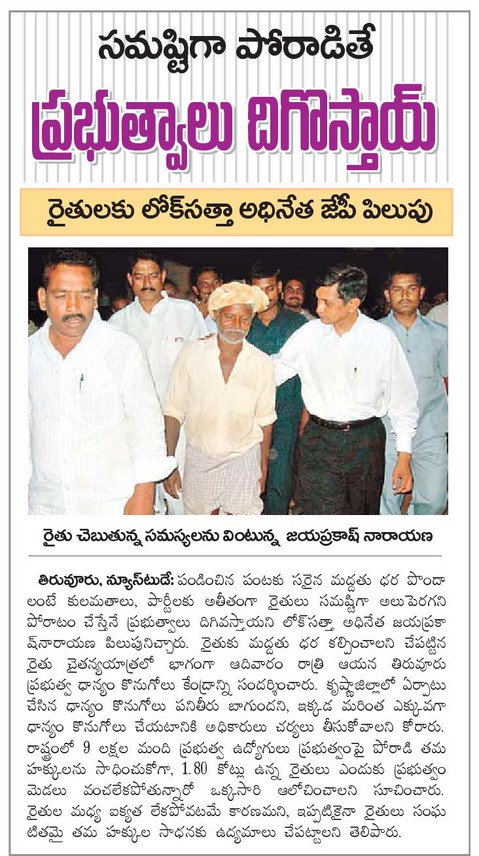
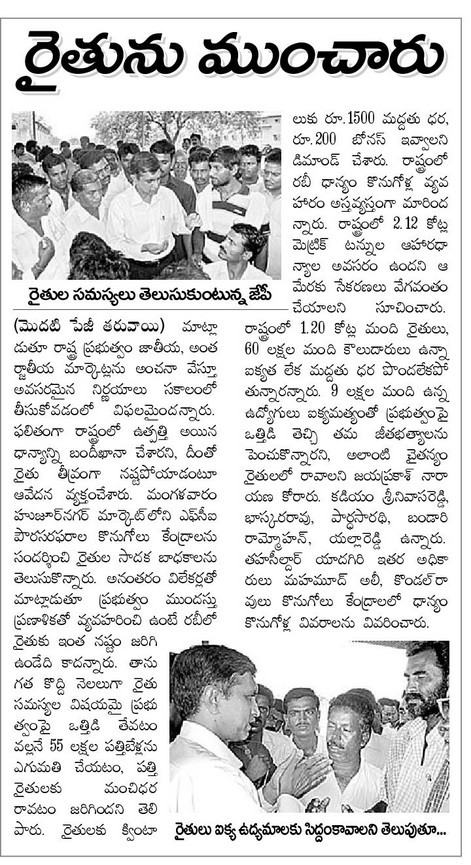
Lok Satta Party President Dr. Jayaprakash Narayan today regretted that all mainstream parties were indulging in competitive agitations on farmers’ immediate problems without going to the roots of the crisis bedeviling Indian agriculture. Dr.JP recalled that the Lok Satta was the first to focus on the structural problems in Agriculture and not on piece-meal agenda.

Addressing a media meet, Dr. JP referred to the spate of agitations in the wake of the heavy damage caused to crops by torrential rains on December 7 and 8 and said that even if the Government conceded all of their demands, some of them unprecedented in Indian history, the crisis in the agricultural sector would not fade away. By focusing their entire attention on the rain havoc, the agitating political parties were overlooking some fundamental issues.

Dr. JP traced the agrarian crisis to successive Governments’ failure to liberalize the agriculture sector. Without the agriculture sector being unshackled, the farmer cannot be rescued.

Dr. JP explained that India produced more food grains and cotton than it consumed and at much lesser cost than in other countries. In contrast, it had a comparative disadvantage in production of oil seeds.

India for instance produced 100 million tons of rice against an annual consumption of about 60 million tons. The production is expected to go up year after year with more and more irrigation projects materializing even as per capita grain consumption is going down because of higher consumption of other food items like eggs and meat, fruits and vegetables. Yet the Government would not permit rice exports and enable farmers to benefit from the high prices prevailing abroad. The excuse was that the poor in the country would suffer if prices go up because of exports. Cotton production too has gone up substantially thanks to farmers switching over to the BT variety. Yet the Government imposed restrictions on cotton exports, with a view to depressing prices and benefiting the indigenous textile industry.

Dr. JP said that the Government adopted double standards in dealing with industry and agriculture. It does not ban export of Nano, a car designed and produced for the common man, under the pretext it might hurt the consumer. It has, however, no qualms in banning or restricting export of rice and cotton.

Again, the Government permitted duty-free import of edible oils, resulting in indigenous oilseed prices and cultivation going down. India imported nearly 60 percent of its edible oil requirements. A solution lay in imposing a stiff duty on imports and utilizing the proceeds to promote oilseed cultivation in India.

Dr. JP said that farmers would get remunerative prices if the Government promoted storage and processing of semi-perishable and perishable commodities to add value to them and compress the market chain between the producer and the consumer to reduce the number of intermediaries.

Dr. JP pointed out that the country every year produced millions of unemployable educated youth even as the manufacturing sector complains of a serious shortage of skilled personnel. The hordes of these unemployed youth have become the raw material for political parties and leaders pursuing their sectional agendas. Unless energetic steps are taken to provide skills to the youth and create millions of jobs, the nation will be in deep crisis, and the economy will be ruined. Most of these unemployed youth are migrating from villages in hope of a better life in towns, but to no avail.

Dr. JP recalled that Chinese leaders have been deeply concerned about unrest among youth although they provided livelihood to 140 million youth in the last 15 years by promoting small towns and small enterprises. In India, manufacturing hardly accounted for 10 percent of the total workforce of 330 million. Unless manufacturing grows and provides employment opportunities, the unrest among youth is bound to go up. The Government should take up a massive program to impart skills to the youth and enable them to earn their livelihood in manufacturing.

Resolution of farmers’ problems and skilling of youth should become the sheet-anchors of Lok Satta politics, apart from fight against corruption and empowerment of local governments.

Sunday, December 19, 2010 - 13:35

Power struggle in Congress Punishing people: Lok Satta

The power struggle within the Congress is aggravating people’s miseries in Andhra Pradesh, commented the Lok Satta Party here today.

Talking to the media, Lok Satta Party leaders V. Laxman Balaji, P. Bhaskara Rao and Ravi Maruth pointed out that a paralyzed administration had failed to address the two burning problems – the agrarian crisis and widespread corruption.

The Lok Satta leaders at the outset pointed out that the resignation of Mr. Y. S. Jaganmohan Reddy and his mother Mrs. Vijayalakshmi from the Congress, and the Lok Sabha and the Assembly respectively, is an internal matter of their party on the surface. The 14-month-old power struggle within the ruling party, however, has been playing havoc with people’s lives.

They referred to reports of small and marginal farmers burning away the paddy crop ripe for harvest, unable to pay daily wages ranging from Rs.300 to Rs.400 to agricultural laborers. The Government had abdicated its responsibility of ensuring fair and remunerative prices for paddy. It remained a silent spectator as rice millers exploited the hapless farmers. It has not bothered to announce the State advisory price for sugarcane even on the eve of the harvest whereas the U. P. Government fixed it as Rs.250 a quintal.

They reiterated the party stand that the Mahatma Gandhi National Rural Employment Guarantee Scheme be extended to cover agriculture so that farmers did not face shortage of labor even as workers found gainful employment.

The Lok Satta Party leaders said that corruption had become rampant as a weak Government would not initiate any measures to combat it. They referred to the Supreme Court observation that something is rotten in the Allahabad High Court and said the same could be said of every sphere in Andhra Pradesh.

They disclosed that Lok Satta Party President Dr. Jayaprakash Narayan would be leaving for New Delhi on a three-day visit to discuss the agrarian crisis with the Prime Minister’s Economic Advisory Council Chairman Dr. C. Rangarajan, Chief Economic Advisor to Government of India Kaushik Basu, and Planning Commission members. He will discuss electoral reforms as one of the means to combat corruption with members of the Election Commission of India. The Lok Satta has already taken some initiatives for the formation of a National Judicial Commission to pre-empt and punish corruption in the judiciary.

Monday, November 29, 2010 - 17:16

Pages