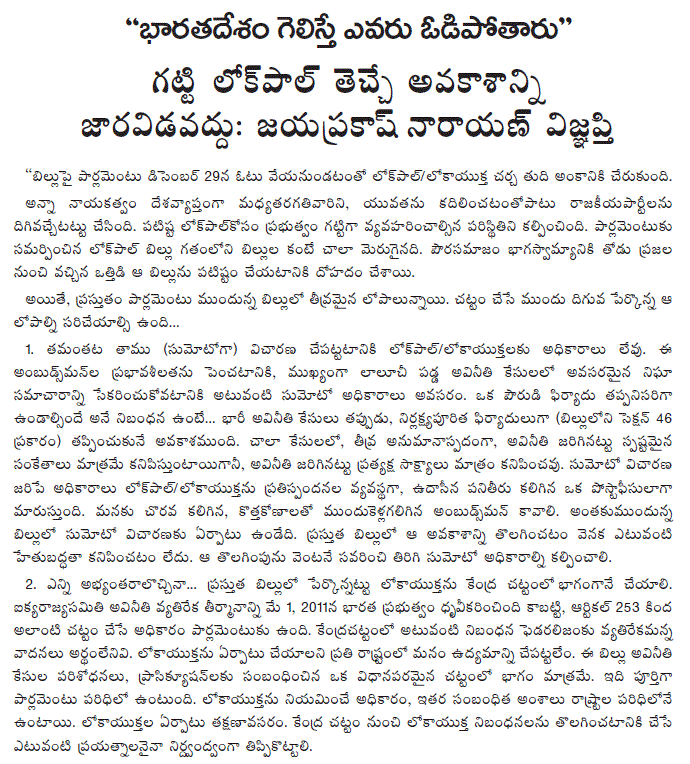
భారతదేశం గెలిస్తే ఎవరు ఓడిపోతారు - గట్టి లోక్ పాల్ తెచ్చే అవకాశాన్ని జారవిడవద్దు: జేపీ విజ్ఞప్తి


Tuesday, December 27, 2011 - 18:38

The Lokpal / Lokayukta debate has reached the final stage, with the Parliament due to vote on the Bill by December 29.
Anna’s leadership has galvanized the middle classes and youth across the country, and sensitized the political parties and government to the urgent need for resolute action. The Lokpal, Lokayuktas Bill presented to Parliament is a vast improvement on the past Bills, and is directly a product of civil society involvement and public pressure.
However, this Bill has serious lacunae which need to be addressed before the law is enacted.
The Lokpal / Lokayuktas have no powers of suo-motu enquiry. Such powers are vital to enhance the efficacy of these ombudsmen, and ability to gather intelligence, particularly about collusive corruption. If a complaint of a citizen is mandatory, many cases of gross corruption may escape attention as false, frivolous or vexatious complaints will invite penalties (Section 46 of the Bill). In many cases, there can only be grave suspicion and circumstantial evidence, and direct evidence of corruption will not be forthcoming. Absence of powers of suo-motu enquiry will convert Lokpal/ Lokayukta into a reactive, passive post-office. We need pro-active, innovative ombudsman. The earlier Bill provided for suo-motu enquiry. There is no rational explanation for its deletion in the Bill now, and this omission should be rectified.
Lokayukta should be part of the central law as envisaged in the present Bill. Article 253 clearly gives parliament the power to make legislation since the United Nations Convention Against Corruption has been ratified by India on May 1, 2011. The argument that such a provision in a central law is against federalism is disingenuous. We cannot have a movement in every state to create Lokayukta. In any case, this Bill is a part of procedural law dealing with investigations and prosecution of corruption offences. This is entirely within the Parliament’s jurisdiction. The power of appoint the Lokayukta and other related matters vest in the States. Creation of Lokayuktas is the need of the hour, and any efforts to delete Lokayukta provisions from the central law should be firmly resisted and rebuffed.
It is vital to have Local Ombudsmen in States under Lokayukta’s control and supervision. These local ombudsmen, one per district, can deal with lower bureaucracy, and will report to Lokayukta. Thus, jurisdiction over local bureaucracy will vest in Lokayukta even as the institution is not swamped by cases of petty corruption.
Anti-Corruption Bureaux at State level are completely untouched by the present Bill. Unless they are directly under Lokayukta’s superintendence, status quo will continue and they will be politically manipulated. Unlike in case of the CBI, the appointments of ACB director and senior officials are completely under political control in states. The appointment of director of CBI by a collegiums of PM, Leader of Opposition and Chief Justice of India is a vast improvement. Officials of CBI are appointed under CVC Act by a collegiums headed by full CVC. In states no such provisions exist. It is vital that ACB is brought under Lokayukta’s superintendence.
Section 6A of the Delhi Police Special Establishment Act, Section 19 of Prevention of Corruption Act, and Section 197 of CrPC continue unchanged, and only cases referred by Lokpal / Lokayukta are exempted from these legal impediments. CBI and ACB are rendered ineffective to act independently in respect of cases directly taken up by them. This is a travesty of rule of law, and makes these agencies helpless in combating corruption. These three provisions should be completely repealed. If any prior sanction of prosecution is deemed necessary, such powers should be vested in the Lokpal / Lokayukta.
All these improvements are rational, balanced, and in public interest. There is no case to deny these amendments. Until these changes are incorporated, the Bill before Parliament continues to be defective. Therefore, Anna is right in arguing for improvements in the law before enactment.
We have come a long distance over the past few months – thanks to public pressure and enlightened political response. Both people and Parliament are partners, not adversaries. We now need wisdom and foresight to do the right thing and inspire confidence in the nation that public interest is fully protected. In pursuit of this goal, we are all one – there is no distinction of party, creed, region or language. There is no civil society – politician divide. We all stand together for this common cause.
We earnestly appeal to all the political parties and Members of Parliament to set aside their differences and act in concert decisively to create a durable, strong, independent machinery all across the nation to exorcise the canker of corruption from our body politic. This is a priceless opportunity to move India into a higher orbit, and it should not be squandered.
As Jawaharlal Nehru admonished us wisely, “Who loses if India wins; And who gains if India loses!”
Dr Jayaprakash Narayan
Lok Satta


Lok Satta Party President Dr. Jayaprakash Narayan today demanded that the Lokpal at the national level and Lokayuktas in States should be armed with powers to take up corruption cases suo moto.
Addressing a media conference on the Lokapal and Lokayukta Bill now before Parliament, Dr. JP pointed out that under the present provisions in the Bill the ombudsmen can take up cases only when there are specific complaints. People will be deterred from lodging specific complaints because of the provision that those who make false, frivolous and vexatious complaints invite a jail term of up to one year and a fine of Rs.100000.
The ombudsmen should look into cases where circumstantial evidence warrants an inquiry without waiting for a complaint. None can make a specific complaint with evidence of hundreds of crores of rupees changing hands in cases like allocation of the 2-G spectrum or award of contracts under Jalayagnam in Andhra Pradesh, although it is public knowledge that they reeked of corruption. Otherwise, monumental and startling cases of corruption go without a probe and the guilty being punished.
For the ombudsmen to be effective, they should be provided an independent intelligence wing, Dr. JP suggested. Only when the ombudsmen have knowledge of issues and reputation of public servants can they make rational judgments as to the relative importance to be accorded to the cases before them. Otherwise, trivial cases will dominate at the cost of important cases of gross corruption of those in high office.
Dr. JP said that although the Lokpal and the Lokayuktas have been freed from seeking prior Government permission for inquiring into and launching prosecution in corruption cases coming up before them, the Central Bureau of Investigation and the Anti Corruption Bureaus have not been freed from taking prior clearances in cases handled by them directly. Therefore, Section 6 A of the CBI Act (Delhi Special Police Establishment Act), Section 19 of the Prevention of Corruption Act, and Section 197 of the Criminal Procedure Code should be repealed.
Dr. JP said that although the Bill takes great care in regard to the selection of the CBI chief and other officials, it fails to address the appointment of Anti Corruption Bureau Directors and others in States.
States have become the epicenters of corruption in the post-liberalization era. Of the total 2.2 crore Government employees in the country, the States account for nearly 1.6 crore. Of the 5000 total legislators in the country, 4000 are in States. Of the 700 ministers both at the Center and in States, 600 are in States. For tackling corruption at the State level which hurts a vast majority of people, the ACB should be autonomous and independent and not be at the mercy of those in power.
Dr. JP said that the ombudsmen would have to be judicious in taking up cases for inquiry as there is the prospect of their being flooded with cases against thousands of people who have all been brought under their purview. In the ideal situation, the ombudsmen would focus on Ministers and legislators at the Center and in States and top officials. They should not equate a person accepting Rs.100 with a Minister accepting crores of rupees as a bribe, a probability if the ombudsmen go by the letter of the law.
Dr. JP said that to fight corruption some more laws like the one drafted by the Law Commission for attachment of the entire property of the corrupt person, and another to go into cases of collusive corruption are necessary. The mechanism to unearth black money should be strengthened.
Lok Satta Party's acting Working President V. Laxman Balaji and General Secretary Katari Srinivasa Rao took part in the media meet.