
Press Releases Archive

Lok Satta complains to CEO on corrupt Practices in MLC elections

The Lok Satta Party today represented to the Election Commission of India to take cognizance of the corrupt electoral practices in the elections to the AP Legislative Council on May 7 and act swiftly and decisively to curb them.

In a memorandum presented to Dr. I. V. Subba Rao, Chief Electoral Officer, Election Commission of India, Lok Satta leaders Katari Srinivasa Rao, V. Laxman Balaji, and P. Bhaskara Rao referred to reports of widespread instances of bribing of voters, bussing of voters to ‘camps’ outside the State and other attempts at intimidation. “Such brazen attempts constitute nothing but corrupt electoral practices under the Representation of the People Act.”

The Lok Satta said that although vote buying through money and liquor has been a feature of elections, new depths were reached in elections to the Legislative Council in that such illegitimate expenses have already exceeded Rs.15 crore for one seat of the RR District local authorities’ constituency with 653 voters.

“If such brazen attempts to hijack the electoral process are allowed without hindrance, ‘free-and-fair elections’ would be reduced to a mockery and all canons of democracy and free exercise of franchise will stand violated.”

Talking to the media, the Lok Satta leaders said that direct election of heads of government ranging from Chief Minister to sarpanch, and election of legislators and others through proportional representation alone would curb money power in elections.
Thursday, May 6, 2010 - 17:05

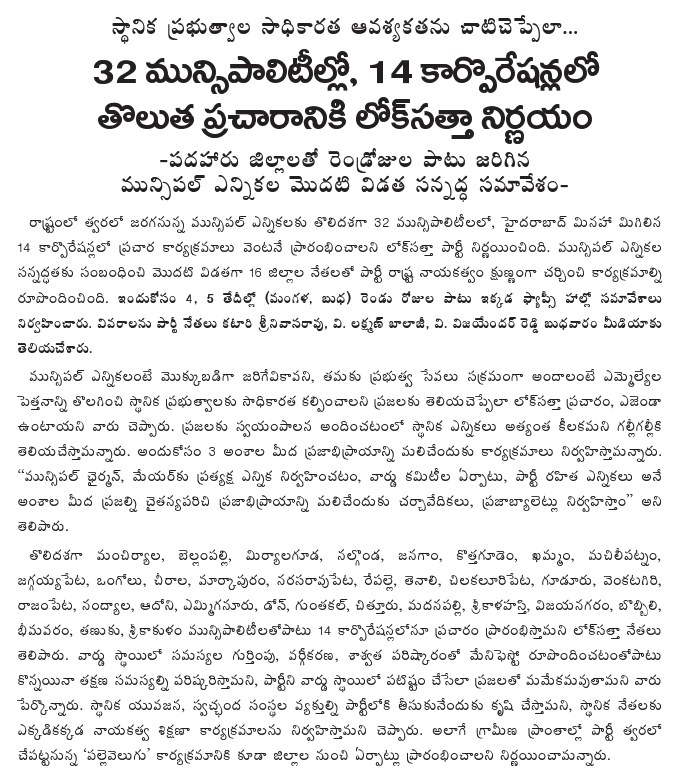
Lok Satta to campaign for non-party Municipal elections

The Lok Satta Party is seeking non-party elections to municipalities and municipal corporations as also direct election of municipal chairpersons and corporation mayors and formation of ward committees.

The party has decided to launch its campaign for municipal elections in 32 municipalities and 14 municipal corporations immediately.

The State leadership of the party held a meeting with leaders of 16 districts here on May 4 and 5 to finalize the party strategy for the civic elections likely be held in September 2010.

Giving this information to the media here today, party leaders Katari Srinivasa Ra, V. Laxman Balaji and V. Vijayender Reddy said the party would focus on the need for empowerment of local governments to improve governance. It would organize discussions and conduct ballots on the need for non-party and direct elections and ward governments. Preparation of ward manifestos and induction of youth and NGO representatives into the party would form part of the campaign.

In the first phase the party will launch the campaign in the following: Municipalities: Manchiryal, Bellampalli, Miryalaguda, Nalgonda, Jangaon, Kothagudem, Khammam, Machilipatnam, Jaggayyapet, Ongole, Chirala, Markapuram, Narasaraopet, Repalle, Tenali, Chilakaluripet, Gudur, Venkattagiri, Rajampet, Nandyal, Adoni, Yemmiganuru, Done, Guntakal, Chittoor, Madanapalli, Srikalahasti, Vizianagara, Bobbili, Bhimavaram, Tanuku and Srikakulam.

The party will launch the campaign in all the corporations going to the polls.

The party wanted the Government to assure college managements that it would reimburse the Backward Class students’ tuition fee and relieve the students of stress during examinations.

Wednesday, May 5, 2010 - 16:11

Letter to CM on Ombudsmen

01st May 2010

Sri K. Rosaiah
The Chief Minister of Andhra Pradesh
Secretariat
Hyderabad.

Dear Sri Rosaiah garu,

This communication is regarding the recent decision of the AP Government to appoint ombudsmen to go into irregularities in the implementation of NREGS (AP GO Ms No. 142, dated 21-4-2010 and the Government of India (Ministry of Rural Development)’s Order dated 7-9-2009).

Lok Satta Party has always been a strong advocate for establishing independent, fully empowered and statutorily-constituted ombudsmen at the district-level as effective instruments of transparency and accountability in public service delivery and the implementation of various government schemes. While we welcome your government’s recent step towards constituting the body of ombudsmen under NREG Act at the district level, the present scheme of their powers and functions would not serve the required purpose. It is evident that there is an urgent need to duly reconstitute this ombudsmen mechanism.

We therefore request you to examine and act upon the following critical issues:

  • At present, around Rs.2000 crore a year is being spent directly at the district-level, under various schemes. Therefore, the powers of the ombudsmen must not be limited only to the implementation of the NREGS, but should be enlarged to cover any instances of corruption and irregularities in all schemes at the local government-level.

  • At present, the NREGS ombudsmen’s powers are limited only to inquiry into irregularities thrown up by NREGS social audit. The scope of their powers must be expanded to enable them to take up and act upon complaints of corruption and mal-administration against both elected members and officials at the local government-level. This would enable them to:

    • lodge or take up complaints (suo motu) against erring parties
    • conduct investigations
    • initiate proceedings on any related grievance, and
    • award and implement redressal, disciplinary and punitive actions against erring parties.

    Ombudsmen must be made autonomous and powerful – under the existing provisions of law, to ensure that guilty elected public representatives and local government officials are removed from service and duly punished.

  • The AP Government has prescribed that retired judicial personnel who have served not below the rank of Judicial Magistrate First Class (JMFC) be appointed as district ombudsmen for the NREGS. Instead, persons of the rank of District Judge should be selected as district level ombudsmen to ensure that the expanded powers and functions over various aspects of district-level governance are exercised, as recommended above.

  • The remuneration awarded to the ombudsmen too should be enhanced to accordingly. In any case, the present notified sitting fee of Rs.500 a day allowed for an ombudsman is too low and impractical an amount, and therefore would not attract talent. Instead, a permanent Ombudsman monitoring and investigating complaints relating to all government schemes at district and sub-district levels or for metropolitan cities should enjoy the status, rank, salary, allowances and privileges of the sitting judge of the same rank. Since there will be one Ombudsman for all programmes including NREG Act, it will be cost-effective."

  • Finally, multiplicity of agencies dealing with wrongdoings of public servants should be eliminated by integrating the functional jurisdiction of various such agencies. To this extent, the district-level ombudsmen mechanism should be integrated at the State level, under an appropriate, independent framework.

The Sixth Report of the 2nd Administrative Reforms Commission (ARC) of India also emphasized upon these issues (subsequently echoed by the 13th Finance Commission, 2010 - 2015), which are integral towards establishing an independent and fully empowered Ombudsman mechanism at the district level to ensure due accountability and transparency in governance at the third tier of the government.

I therefore urge you to act immediately to create a body of effective, independent, empowered Ombudsmen – one per district on the lines suggested above.

With warm personal regards,

Sincerely,

Jayaprakash Narayan

Saturday, May 1, 2010 - 16:17

Pages